The Securities and Exchange Commission’s enforcement chief decried rumors that the SEC’s enforcement arm was falling short on the same day SEC Chair Paul Atkins sidestepped questions about the agency’s dismissal of several high-profile crypto-related investigations.
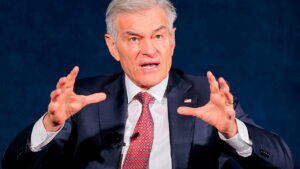
During a speech before the Los Angeles Bar Association at the 56th Annual Securities Regulation Seminar on Wednesday, SEC Enforcement Division Director Margaret Ryan said notions that the enforcement at the SEC “has been tossed to the wayside are not only exaggerated but flat out wrong.”
However, Ryan also argued that she was “far more concerned with the quality and impact” of their investigations than “chasing numbers.”
“And the reality is that I do not have unlimited resources at my disposal,” she said. “As such, I focus on using the resources we have judiciously—that is, where they can most effectively and fairly be used to protect investors and our capital markets.”
Atkins named Judge Ryan as the agency’s enforcement director in September. Ryan was an active-duty U.S. Marine Corps communications officer during deployments to the Philippines and the Gulf War. In 2006, President George W. Bush nominated her to serve as a judge on the U.S. Court of Appeals for the Armed Forces.
Wealth Management named Ryan one of its “2026 Ten To Watch” due to her role overseeing the enforcement division amid drastic changes at the agency during the Trump administration.
Since the start of President Donald Trump’s second term, the division (and the agency as a whole) has undergone a decline in enforcement actions and workforce reductions. As of last May, Atkins reported to Congress that the agency’s workforce had declined by 15% since the start of 2025.
According to Cornerstone Research and New York University, enforcement actions against public companies dropped 30% in FY 2025, with over 90% of those actions occurring during the closing days of Joe Biden’s presidency and former SEC Chair Gary Gensler’s tenure. Additional research from Cornerstone indicated that cryptocurrency enforcement at the agency dropped from 33 actions in 2024 to 13 in 2025, a 60% year-over-year drop. (Five of those 13 actions were brought before Gensler departed in January 2025.) Additionally, Cornerstone found that monetary penalties in 2025 against digital-asset market participants were $142 million, less than 3% of 2024’s total.
During Atkins’ testimony Wednesday before the U.S. House of Representatives’ Financial Services Committee, Rep. Stephen Lynch (D-Mass.) focused on the agency’s crypto enforcement, arguing that “the reputational damage the SEC is suffering right now is unbelievable.”
Particularly, Lynch focused on the dismissal of the case against Binance, alleging that terrorist groups and criminal networks used the digital asset platform; after the commission dismissed the case, Trump pardoned Binance founder Changpeng Zhao, and the company subsequently promoted stablecoins in World Liberty Financial, a crypto business related to the Trump family.
“Statutorily, your No. 1 responsibility is to protect consumers and to maintain trust in our securities industry. How does what you are doing protect the consumer?” Lynch asked Atkins during testimony. “It boggles my mind that this is going on and there are no consequences to what the president is doing.”
Atkins demurred during questioning, briefly stating he could not comment on the details of a specific case, but said the agency had “a very robust enforcement effort and was bringing cases against fraud.”
The tense back-and-forth followed a January letter from Democratic lawmakers to Atkins, who said the commission’s moves to dismiss enforcement actions against prominent crypto players, coupled with the Trump family’s involvement in the space, “has created the unmistakable inference of a pay-to-play scheme.” The legislators noted that crypto companies had donated at least $95 million to the re-election campaign, with others donating heavily to Trump’s inauguration.
Lawmakers urged the agency not to take the same approach in the case of Justin Sun, a crypto player accused by the SEC during Gensler’s tenure of manipulative trading practices (and who has since invested at least $75 million into World Liberty Financial, while serving as an official advisor).