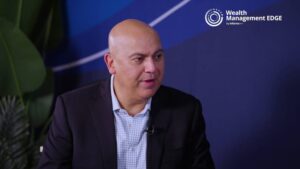

When selling an advisory practice, founders should be aware that fewer business obligations will usually also come with a sharp drop in annual income, the head of an acquisitive registered investment advisor told advisors at Wealth Management EDGE, held at The Boca Raton resort in Boca Raton, Fla., last week.
Speaking on a panel about succession planning, Andrew Rosen, executive chairman at Diversified, said he often runs into a snag when talking to advisors looking to sell, as they start getting into the details of being paid solely on their EBITDA, not the full business.
“What happens is these individuals, when you start to break down the economics that their salary is now going to go from $700,000 to a few hundred thousand, it blows their mind,” Rosen told the audience. “They can’t understand the fact that what you are buying from these individuals is that profit. They are making $700,000, not because they’re a great advisor. They’re making a few hundred thousand for being a great advisor, and then a few hundred thousand for being a business owner.”
Rosen said that, at that stage of the conversation, advisors often become concerned that the reduced annual take-home will impede their pre-retirement plans, despite the liquidity gains from the sale.
“It boggles your mind, because you just think they’ve told clients for the past 40 years how to do [an exit],” said Rosen, who leads the more than $3 billion in assets RIA. “That’s a big challenge that I run into—people get so stuck on this company as funding their whole lifestyle that they can’t make that mental transition.”
Tom Orecchio, the CEO of Modera Wealth Management, said the firm had encountered sellers in the opposite position: they were financially ready for the move but struggled to transition right to full retirement.
“We also see it where people aren’t prepared because they’re going from 100 miles an hour to zero very quickly rather than going through a smoother transition,” he said.
Orecchio said Modera has set up a succession program in which selling advisors have projects related to the business or the transition.
“We try to provide that off-ramp,” he said of the Westwood, N.J.-based RIA with over $17.5 billion in assets under management.
For advisors thinking about selling, Orecchio said one of the best things they can do for the future is to build their team so that they are “dispensable.”
“We work in teams, and I think the best way to know you’re prepared for succession is when you become not needed on the team,” he said. “I know a lot of advisors don’t want to feel that way, but making yourself dispensable is definitely the best way to ensure that you’ll have a smooth succession, either off the team or out of the business altogether.”
According to Cerulli Associates, whose Stephen Caruso moderated the session, it recently projected that 26,000 advisors will be retiring over the next decade, making it the “largest addressable market for RIA acquisitions in terms of assets under management.”
RIA leaders Rosen and Orecchio agreed that selling advisors often focus too much on the sale multiples being offered rather than the deal terms.
Orecchio noted that terms that cover flexibility, off-ramp preferences and transition structures can be more important than the headline price.
Rosen added that as the market has matured, valuations fall within predictable bands, and well-organized practices with clean systems command better terms.
“There’s an old saying, which is, ‘tell me the multiple you want, and I’ll tell you the terms to get there,” he said. “You want a 20, I’ll get you a 20, but you’re not going to like the terms.”
Both advisors also agreed on one area that advisors should not stress: client retention after a move.
“I’ll tell you the No. 1 misconception: that when you leave, all your clients [leave],” Rosen said. “I’ve never hit [a retention issue]. I mean, our average is actually like 101% retention, because a client might say, ‘Oh great, now my mom will come on board,’ or ‘My son just didn’t want to work with you because you’re going to retire anyway.’ I mean, they know you’re 70, right? It’s not a secret.”