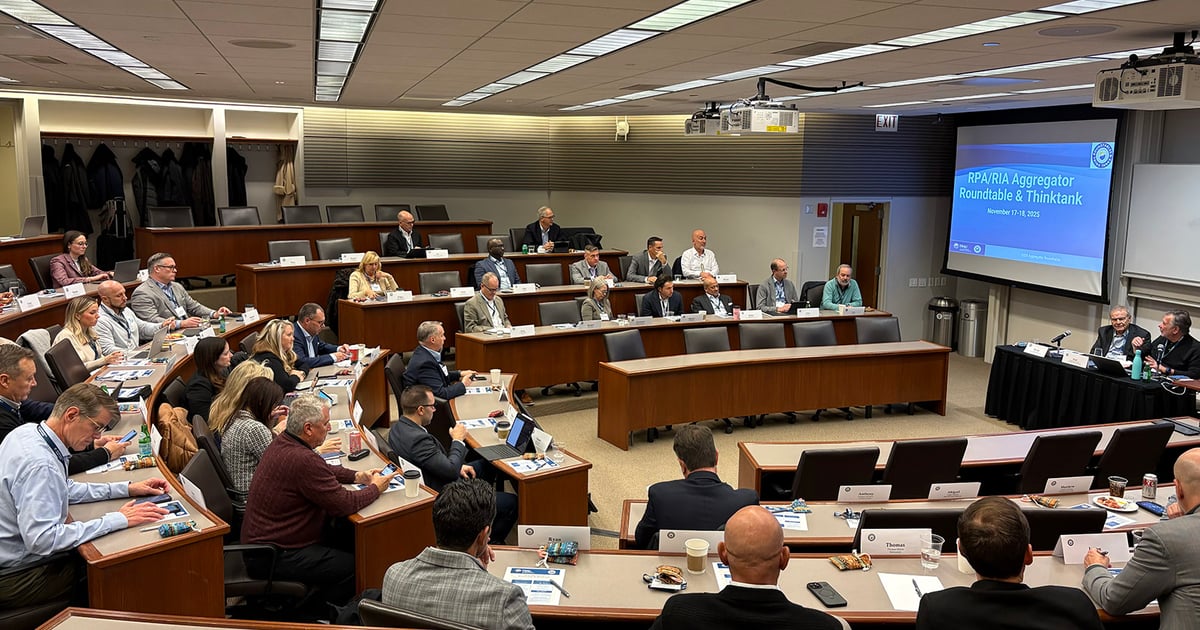
Both RIA and RPA aggregators are at the tip of the spear in the changing landscape of workplace retirement, wealth and benefits, driving much of the change and controlling the narrative as they gather more assets and advisors.
Though exciting, being on the front lines is dangerous as the stakes get higher and competition with other advisory firms and record keepers grows.
At the heart of the discussion at the 2025 Aggregator Roundtable held at the University of Chicago’s Gleacher Center Nov. 17 to 18 with leading firms and providers that support them was how to grow organically and through acquisitions, meeting the changing needs of plans and participants as fees continue to shrink and both advisors and record keepers focus on the convergence of wealth and retirement at the workplace.
While private equity firms continue to invest, both Lew Minsky, DCIIA’s CEO and president, and UCLA professor Shlomo Benartzi questioned whether their time horizons match how long it will take for advisors and providers to truly leverage opportunities at the workplace.
With wealth management a much higher-margin business, with fees increasing, according to Daniel Bryant, co-founder of Sheridan Road, why should wealth advisors be interested in managing 401(k) and 403(b) plans where fees are shrinking?
For Scott Colangelo, chairman and managing partner at Prime Capital, which began as a wealth firm, evolving into a retirement plan advisory practice as well, the reason is personal—he feels he can make a bigger impact at the workplace helping people without a financial advisor than with wealth clients. Jania Stout, Prime’s financial advisor president and head of retirement, a long-time and storied RPA, admitted advice at scale can be cumbersome but not impossible by hiring properly trained low-cost workers.
There are fundamental and real questions about what convergence is and how to leverage the opportunities of $13 trillion in DC plans and nearly 100 million participants, as well as what tools are needed.
If the journey from retirement to wealth were a road trip, the tech, investments and platforms are the vehicles, advisors and financial coaches are the drivers, strategies are the maps or GPS, which need to be constantly adjusted, and data is the fuel without which the trip cannot begin. Issues around data drove much of the early discussion.
Vince Morris, president of OneDigital Retirement + Wealth, noted that advisors need scale to obtain and leverage the data. Stout said that some record keepers are starting to charge for it, even asking to share in advisor revenue. Will Hicks, head of global retirement at FIS, which is about to release cloud-based versions of Omni and Relius, and has 50 million participants on the platform with decades worth of data, asked, “What data do advisors want?” Morris answered, “All of it. Getting it plan by plan or participant by participant is not efficient. We will get it one way or the other.”
Though FIS has the data, Hicks said he needs permissions, especially from record keepers who are his clients. Chris Weirath, SVP at Morningstar, stated her firm gets data from 25 record keepers through their managed account programs and is getting more and enhanced data inside and outside DC plans. Broker/dealers at the September Roundtable indicated more record keepers are willing to provide data than ever.
One of the issues of implementing auto features is payroll integration, with just 24% of smaller plans utilizing auto enrollment, according to Vanguard—payroll data could also help facilitate convergence. There are payroll integrators, but they are not getting all the data and must go through certain tech hoops to be integrated within FIS, which has decided to partner rather than build its own integrator.
Even when data is available, issues remain, with permissions and participant engagement needed for even the most fundamental services like IRA rollovers and managed accounts. Working with a large aggregator, Pete Littlejohn, co-founder and president of IRALOGIX, discovered that $2 billion was rolling out of their plans each month. It’s something Fidelity understood very early, constantly dripping on participants, Littlejohn said. Chris Bailey, director, retirement at Cerulli, noted that their research shows that 54% of rollovers go to advisors with an existing relationship, and those rollovers are 50% to 60% larger.
Another asset drain highlighted by IRALOGIX’s Mitch Haber and Jay Brietenkamp, senior director, retirement services at Inspira, is terminated plans—where does that money go and can advisors capture it?
That led to a vigorous discussion about managed accounts, which has become a lightning rod for convergence. Prime Capital’s Colangelo, whose firm has 45% of assets in managed accounts, strenuously advocated that participants should not be defaulted into them, which is the basis of the Bechtel case against Empower. Rather, Prime’s financial coaches meet with each participant before they are put into a managed account. Brian Nickolenko, vice president at Transamerica, asked how to benchmark them, to which Colangelo said keeping more participants in the plan at higher contribution rates should be a factor.
Jennifer Doss, senior director, DC practice leader at Captrust, said her firm uses managed accounts as a scalable advice platform and a segmentation strategy, noting that participant engagement is more effective when employers lean in. A dedicated participant call center is needed to be able to speak with everyone, with debt consolidation one of the biggest topics this year, according to Jennifer Tanck, EVP at World Insurance.
M&A was brought up during pre-roundtable research by DCIIA’s Warren Cormier, with some wondering whether acquisitions are to get bigger or better. Colangelo noted that there are no shortages of deals out there, and he could do 20 to 30 every year, but integrating them is the challenge. Christian Mango, SVP at OneDigital, warned that there is a reckoning coming for firms that cannot grow organically and integrate.
OneDigital’s Morris stated that cultural fits are becoming a more important factor— Cormier’s research indicated that firms realize that leveraging convergence is difficult for aggregators that remain siloed.
Morris also noted that the DC industry has done a great job going to the average through TDFs, but that we need to get more personalized solutions something echoed by Sheridan Road’s Bryant who thinks the holy grail is to create personas of one with benefits and investments customized for each person, which in turn can save employers money on healthcare and benefits and produce better outcomes.
And while it’s hard to imagine plan fees declining even more, especially for record keepers, FIS’s Hicks indicated that his new platforms can save 40% to 50% in part through containerized code.
No DC meeting can occur today without a discussion of private investments—most believe it is coming to 401(k) plans in some form, but there was no consensus on when and how much. Scott Smith, managing director at Hightower, said there is still limited adoption within his advisors, while Brian Collins, CIO at Hub, said we must educate advisors. Private market investments in DC plans are more complex than in defined-benefit plans because the latter do not have to talk to participants. Collins wondered how much time advisors can afford to speak with investment committees about private investments, given the limited amount of time advisors have with them.
The challenges of the DC market are immense, including the mass of unsophisticated and unengaged investors, heightened ERISA fiduciary oversight, rampant litigation and declining fees and the many parties that need to come together to serve plans and participants. Yet the opportunities at the workplace to cross-sell wealth and eventually benefits cannot be ignored, with only larger, well-capitalized and vertically integrated firms with patient owners growing organically and through acquisitions having a chance of succeeding.
All of which cannot begin without data.
“We are part of the problem,” admitted Colangelo. “We don’t communicate as one on what we need.” Leading Cormier to ask—who is the “data umpire?” The answer, of course, is there isn’t one, nor is there likely to be one, leaving every advisory firm and provider to fend for themselves, with the biggest and brightest most likely to succeed, perhaps not interested in leveling the playing field.