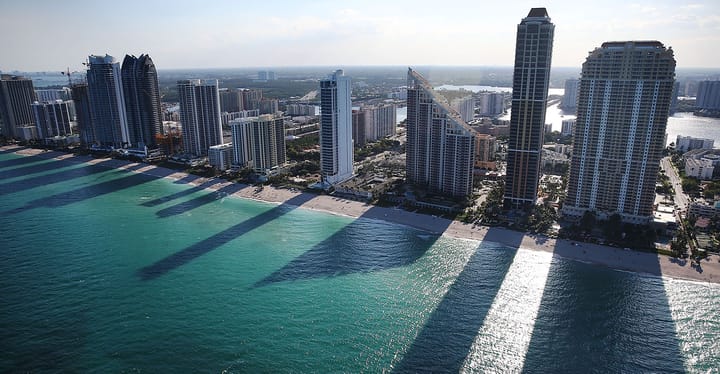
(Bloomberg) — For well-paid professionals grinding it out in Manhattan, the math used to be simple: Real estate, taxes, schools and almost everything else were cheaper in sunny Florida.
Now that Miami has become one of the most expensive cities in the US, the New York-to-Florida arbitrage is a tougher calculation.
For the first time on record, the Miami metropolitan area is more expensive than greater New York City. South Florida’s consumer price index has jumped 36% since 2019 according to figures released this month, more than any of the other metropolitan areas tracked by the US Bureau of Labor Statistics with the exception of Tampa, Florida, four hours away. And Miami’s cost of living has surpassed New York’s, according to the US Bureau of Economic Analysis’s latest annual price-comparison report, which examined 2024 data.
What’s more, Miami’s private-school tuition, insurance costs and even restaurant spending are higher than they were a year ago.
Cost considerations aren’t the only reason people choose to live where they do, of course. In weather, culture and pace of life, Miami still offers a very different proposition from New York City. Yet for professionals pitched on the South Florida dream — the one billionaires like Ken Griffin have helped sell, where Wall Street careers come with lower costs and more money protected from taxes — Miami’s new economics don’t add up.
“People get blinded by the absence of state income tax,” said Nicolas Valdes-Fauli, who is making the move from Manhattan to Miami with his family this July, where they’ll rent an apartment their first year. While he will avoid New York’s steep state and city income taxes, the financial planner estimates those savings will get “wiped out” by other costs, like buying and maintaining multiple cars and paying private school tuition that now rivals New York prices.
“Miami has a way of normalizing lifestyle creep quickly,” he said. “The social pressure around consumption is powerful.” Valdes-Fauli ultimately decided to make the move because his job is based down there, and he’d grown tired of commuting back to New York City on weekends.
One of Valdes-Fauli’s biggest expenses in Miami will be housing. South Florida buyers get more space for their money than New Yorkers do: The median price per square foot in the Miami metro was $357 in June, according to Realtor.com data, compared to $537 for a square foot of a home in the New York City area. But for the financial planner, who is looking to buy a home in prime Miami neighborhoods like Coral Gables, South Miami and Pinecrest, the price-per-square-foot is on par with their Upper East Side apartment. And while he won’t have to fork over co-op maintenance fees, he expects to pay the same or more for homeowners insurance and property taxes in the Sunshine State.
Until recently, a homeowner transferring from Wall Street to so-called “Wall Street South” could count on a substantial windfall from trading their New York apartment for a Florida condo. But prices in the Miami area have surged, up 79% since Covid-19, according to S&P Case-Shiller data. And for those shopping for homes in South Florida, “it’s no longer just about the purchase price,” said Corcoran agent Michael Buttacavoli. “It’s about the total cost to own.”
Six major hurricanes in the last decade and flooding even on sunny days have given Florida the highest home insurance premiums in the nation — an average of $8,292 last year, online marketplace Insurify estimates. Already four times what New York State homeowners pay, Florida premiums are projected to continue rising this year. The Miami area’s property taxes, meanwhile, have jumped 62% since 2019, more than twice the national average, according to real estate data firm Attom.
And new arrivals get the highest bills because longtime residents pay lower rates based on previous assessments on their properties. Governor Ron DeSantis signed a bill in June that would lower the property tax bill for Florida homeowners living in their primary residences. That change would apply to those who have lived in their residences for five or more years — not new transplants. The legislation goes in front of voters in November, requiring at least 60% approval to go into effect.
The total cost of housing in the Miami, Fort Lauderdale and Palm Beach metropolitan area is about 5% higher than in New York and its suburbs, which includes New Jersey, according to the Bureau of Economic Analysis. Southern Connecticut, where many hedge funds are located, is also now cheaper than Miami.
Other living costs are on par with New York too. Miami transplants complain that mid-tier restaurant options are rare, it’s either Carbone or a Cubano. The average diner in Miami spent $94 year-to-date in 2026, up 4% year-over-year, according to OpenTable. (In New York City, restaurant spend per person rose 1% to $79.)
Salaries largely aren’t keeping pace with costs. The Miami metro area’s typical household income is about $1,000 less than the national median, according to the latest US Census Bureau estimates. Even professionals make less in Miami than they do in New York City. The average lawyer in the New York City area earned about $51,000 more last year than one in Miami, BLS data show.
People up and down the income spectrum are feeling squeezed. “It’s just so expensive,” said Cindy Brown, a 64-year-old Florida native. She owns a home that she feels lucky to have purchased in 2004. But she lives with her niece and her niece’s husband “because they can’t afford the rents and they certainly can’t afford to buy.”
Even well-paid professionals like Colby Eisenberg, a 34-year-old advertising sales director, struggle to afford the city. When he first came to Miami in late 2020, he landed a one-bedroom apartment in a Brickell luxury high rise for $2,150 a month. Coming from Los Angeles, Eisenberg felt flush.
“At the time, restaurants, entertainment, parking, and everyday expenses all felt relatively affordable,” said Eisenberg. “I was able to go out frequently, network, and enjoy the lifestyle Miami offered without feeling like every dollar was being stretched.”
By 2022, Eisenberg’s landlord had raised his rent roughly $1,000 a month, pushing him north to Fort Lauderdale. Within a year, his rent there went up several hundred dollars. He’s now living even further up the peninsula in Boca Raton. “It’s discouraging how defeated you feel when you’re outpriced of so many neighborhoods and places,” he said.
Meanwhile, the ultra-wealthy continue to put down stakes in the area. Three of the richest billionaires in the world, Mark Zuckerberg, Larry Page and Sergey Brin have all purchased property in Miami recently. So have former Starbucks chief executive Howard Schultz and Palantir CEO Alex Karp.
Griffin himself has spent hundreds of millions of dollars acquiring residential real estate for his personal portfolio and buying up some 5 acres in the Brickell neighborhood for Citadel. Amid a feud with New York City Mayor Zohran Mamdani, the billionaire also can’t stop talking about the advantages of Miami. Earlier this year, he teamed up with fellow billionaire Stephen Ross to bankroll a campaign to get more CEOs to move to the city.
Stéphan Toupin, who lives a block away from Citadel’s future oceanfront home, is fed up with the Miami boosterism. The traffic is atrocious. The new restaurants are outrageously expensive. Housing costs are spiraling higher: This year, Toupin and his husband were hit with a $35,000 special assessment on top of their $1,200-a-month condo fees. (Massive assessments, often for safety upgrades, have become more common in Miami after a condo building collapsed in Surfside in 2021.)
Toupin founded a company that imports medical devices on behalf of more than 150 manufacturers around the world. His husband works for a bank. Yet, to keep up with soaring costs, the 57-year-old stopped contributing to his retirement accounts, started bringing his lunch to the office and cancelled their typical two-week $15,000 European vacation.
While people making $10 million plus are still flocking to Miami, those like Toupin and Valdes-Fauli – the merely well-off – are far less likely to move to Miami, said Ben Jacobs, a Douglas Elliman agent licensed in both New York and Florida. “Those buyers are not moving to South Florida.”
For them, the tax savings aren’t significant enough, Jacobs said. While Florida has no income tax, it still has plenty of taxes – and the US’s most regressive tax system, according to the left-leaningInstitute on Taxation and Economic Policy. The top 1% of Floridians pay out just 2.7% of their incomes in sales, excise and other levies, while the poorest fifth pay 13.2%. (By contrast, New York State’s top 1% pay 13.5%, while its poorest fifth pay 11.1% in total state and local taxes.)
Now, people moving down south are doing so for the old-fashioned reason: To stay warm. “I’m sick of the cold,” Nicolas Valdes-Fauli, the financial planner, said. “The freedom and flexibility to go to the beach with my family sounds great.”
To contact the authors of this story:
Ben Steverman in New York at [email protected]
Paulina Cachero in New York at [email protected]