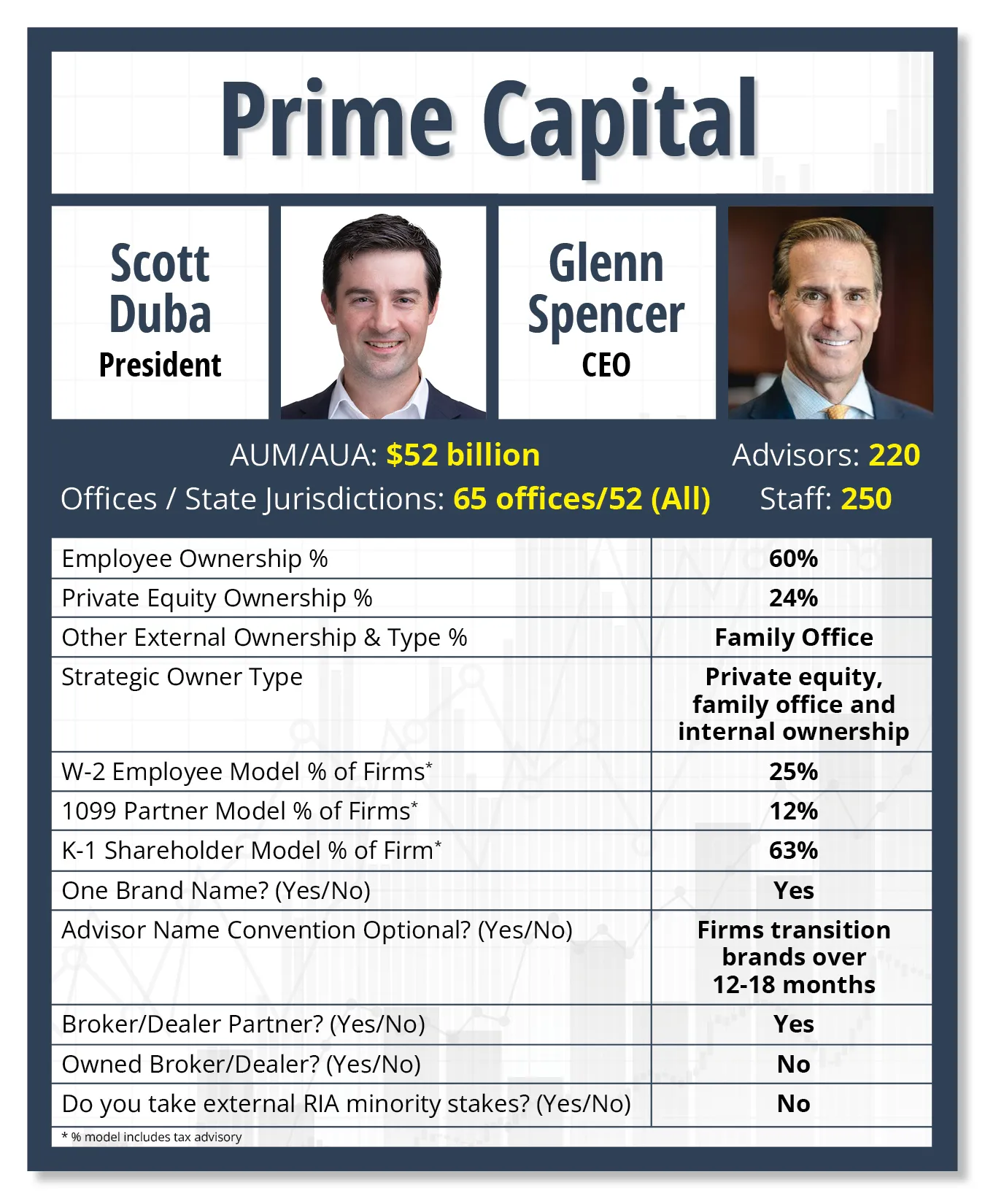
Prime Capital Financial has a unique origin story. In 2017, a handful of advisors bought what was then called Lawing Financial, and from that point on, the vision was to be an advisor-owned business. They stayed true to that vision, as the firm grew from about $2.5 billion to $52 billion today.
Today, 95% of the firm’s AUM is managed by advisors who own equity in the firm. And that’s with an outside funding provider in the capital table. Prime is fresh off a recapitalization, with private equity firm Carlyle taking a minority stake in August. Its previous minority investor, Abry Partners, exited the investment.
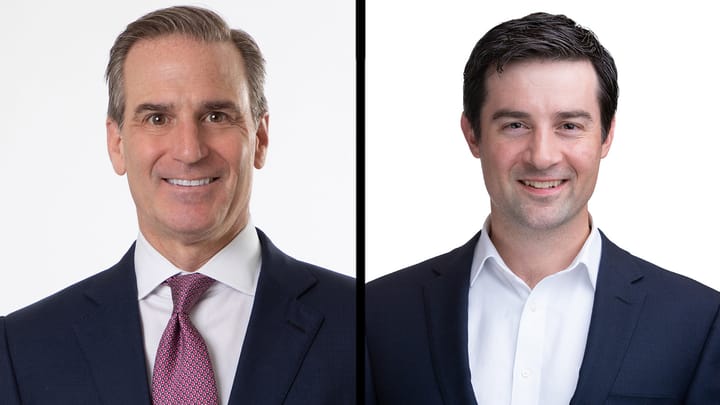
Wealth Management recently spoke with Prime Capital CEO Glenn Spencer and President Scott Duba about the ownership structure, what they’ve built beyond the traditional wealth management model and the next stage of growth with Carlyle on board.
The following has been edited for length and clarity.
Wealth Management: Tell me about the firm’s history.
Glenn Spencer: The company’s roots date back to the 1980s, when it was called Lawing Financial. For the first 12 years, it was a life insurance business, and in 1997, they hired some financial advisors to augment the insurance business from Edward Jones. And they formed one of the first registered investment advisors in the state of Kansas in 1997. By 2017, the firm was 95% investment advisory and 5% insurance, and a handful of advisors and I bought the company from Kerry Lawing. We launched Prime Capital Financial in January 2018, with about $2.5 billion in AUM.
Today, we’re at $52 billion, and along the way, we’ve done about 30 acquisitions and recruited hundreds of advisors. We’ve gone from 40 advisors to 225.
I like to say we’re not an investment advisor; we’re a wealth advisory firm. That means we lead with planning. We have great investment models, but we also have $2.5 billion in alternative investments. We have a $14 million revenue tax advisory business, trust and estate services, a multi-family office, and banking services. We consult on complex insurance transactions. We do institutional consulting for endowments and foundations. Today, nearly 20% of our revenues come from those ancillary services.
WM: What’s the history of the firm’s ownership structure?
GS: Originally, the five of us bought the company. But the vision from the beginning was to be an advisor-owned business. When you look at other professional services industries, all the great firms, whether it’s Bain, McKinsey, a big global law firm, PWC, they’re all partnerships of practitioners.
In 2021, we brought 70 additional owners in, bringing the total to 75. Today, we have 170 partner owners in the company, and we have outside capital, with Carlyle owning about 25%. So 75% of the equity roughly is advisors and employees. It’s actually a little bit lower than that because we do have a passive family office investor as well.
If you look at our competitors, I don’t think there’s anybody out there that has as diverse a capital table, and most of them are having to transact, i.e., sell the entire firm, because the principal owners need to get liquidity. We can solve any liquidity need. We buy back equity from people based on age and stuff like that, but we’re continuously purchasing equity from people in the cap table. And if a relatively large holder of equity needed to cash out, that problem could be solved very easily and without doing a controlled transaction.
Scott Duba: The vision from 2017 on was to have advisor owners, just because the mindset of an owner is so much more powerful than the mindset of an employee. Distributing equity to a lot of the advisors five years ago was a very important moment for the firm, as we’ve maintained this advisor-owner culture. North of 95% of our AUM is managed by advisors who own equity, which is very different from a lot of other places. It has all these derivative benefits in terms of people being more motivated to serve their clients in the best possible way, being collaborative with their colleagues, and being willing to help us stand up new capabilities to serve their clients.
Especially in M&A, it’s hard to manage culture when you’re growing via M&A. But because so many of our advisors, nearly all of them own equity in the firm, there’s tremendous alignment in terms of what we’re doing and what we’re building. When we went through our recap process, I think that was one of the key differentiators that really attracted Carlyle and others to the story.
GS: With any acquisition we do, when a new advisor joins and they have a significant book of business, they are required to be an equity holder in the company. So it’s critically important. I mean, just to this whole topic of cap table, we think it’s critically important to have really tight alignment of interests between advisors and the organization.
We have Carlyle as an equity provider, and they have committed to providing additional equity investment to the extent we need it. So we’ve got a facility, if you will, that we can raise money from. And then Ares leads our credit facility, which is another component. When we think of investing in the business, we have capital on hand, we have a credit facility, and we have an equity facility.
WM: What’s your M&A strategy? What other growth levers do you have?
GS: We’ve acquired a number of RIAs, but we think a lot about capability, too. We acquired the accounting advisory business and we acquired the family office business. So we’re curious about businesses that are ancillary to the core planning and investment advisory.
Recruiting is also an area of investment for us. We’ve recruited as much AUM as we’ve acquired over the past seven or eight years. The final area of investment is organic growth. We have double-digit organic growth, and we’re investing more in that capability, lead generation, teams to close the business, and hand it off to advisors.
WM: What does the credit facility look like with Ares? How is that structured?
SD: It’s similar to most PE senior facilities you would see, with a non or lightly amortizing term loan B portion for the majority of it. The second component would be a delayed-draw term loan, to the extent we need financing for additional acquisitions or recruitment. The third part would be a revolving credit facility. Ares is by far the biggest lender in the private markets, and especially in the wealth space.
WM: Glenn, you mentioned that the firm can provide liquidity and equity without a controlled transaction. How are you able to do that?
GS: We’re able to just because the equity is so dispersed. We have 170 equity holders.
We have several individuals who are in the $100 million range in terms of equity. But for an organization of our size with our profitability, raising that is not a significant issue. We didn’t necessarily sit down eight years ago and say, “We can create liquidity for people if we disperse the capital table.” It was really intended to be an alignment of interest, but an ancillary benefit is that since the equity is so dispersed, it’s easy for us to solve liquidity problems because everybody doesn’t want to sell at the same time. And by the way, our equity has performed really well, so we don’t have a lot of people wanting to sell.
About 85% of the people took some liquidity when Carlyle came in, and that’s what got Carlyle up to the 24%.
WM: You have a little bit of a history of taking outside capital. What made you decide to first take outside capital?
GS: The first transaction we did was in 2019. So we had borrowed a significant amount of money to buy the company originally, and so we just exchanged equity for debt. You could argue it was expensive, but at the time, it freed up capacity to pursue M&A. We took our debt down to zero when we took that first equity investment from LNC Partners. In 2023, Abry replaced LNC.
WM: What’s the next stage of growth for Prime now with Carlyle on board?
GS: Our goal is to double our value every four to five years, and we can do that. That requires 25%-ish growth annually. And if we do three or four acquisitions, recruit a dozen to 15 advisors and have an organic growth rate around 10%, we easily get over that hurdle.
SD: There are 10,000 RIAs, and there are a couple hundred transactions every year, people selling. New RIAs are created every year. In the past eight years since our founding, we’ve always taken a very long-term view about building the best professional services firm in the world and delivering the best client experience we can within wealth management. And I would say we have a long runway in the context of how fragmented and large the space is. And Carlyle, I think, recognized that in spite of the tremendous financial success we’ve had thus far, our market share is fairly low at a national level, and we’ve pulled together a lot of very unique complementary pieces from a capability set that’ll enable us to continue to do what we’ve done in the past, which is double every four to five years.
WM: Would you ever consider selling a majority stake to a private equity firm or an outside investor?
GS: I’ve been around long enough to know I would never say “never.”
If we double in size in four or five years, Carlyle will want to get some liquidity, so they’ll just switch their equity out for another partner. And we would create a liquidity opportunity for all the existing owners at that point. I can’t imagine a scenario in which that would be a majority transaction, but then, when you do it again five years later, I could see us vacillating between 40 and 60%, and it might cross over the 50% and then go back down because you’re bringing in new partners.
Would we be 90% owned by outside capital? I can’t see that happening, but there’s probably a scenario where it may tip over 50% at some point.
WM: Do you have a succession plan in place, and what does that look like?
GS: All of our senior leaders in the company are tasked with having a succession plan for themselves. And then at a company level, Scott was just announced in January as president of the company, and he was the chief investment officer before. So his succession plan was a guy named Will McGough, who’s now our CIO, and Scott took broader responsibilities as the president. So that logically puts Scott in a position of succeeding me.
WM: Do you have a program for developing younger or associate advisors? What have you been doing on that front?
SD: On the advisor front, we’re probably approaching year five of our advisor development program, where we’ll take about a half dozen or a dozen advisors through the program annually. It’s a pretty intensive third-party training on how to engage with clients, how to sell, how to grow your practice, all the typical things that you don’t really learn in college.
In addition to that, we’re in year two of our leadership development program with managers in the company. That spans our investment team, our trading team, our financial planning team, our tech team, operations, retirement. That’s another program that we run with third-party partners. We meet about quarterly for an on-site event, with a couple of days of content for them, and we’ll do that on a cohort basis as well.