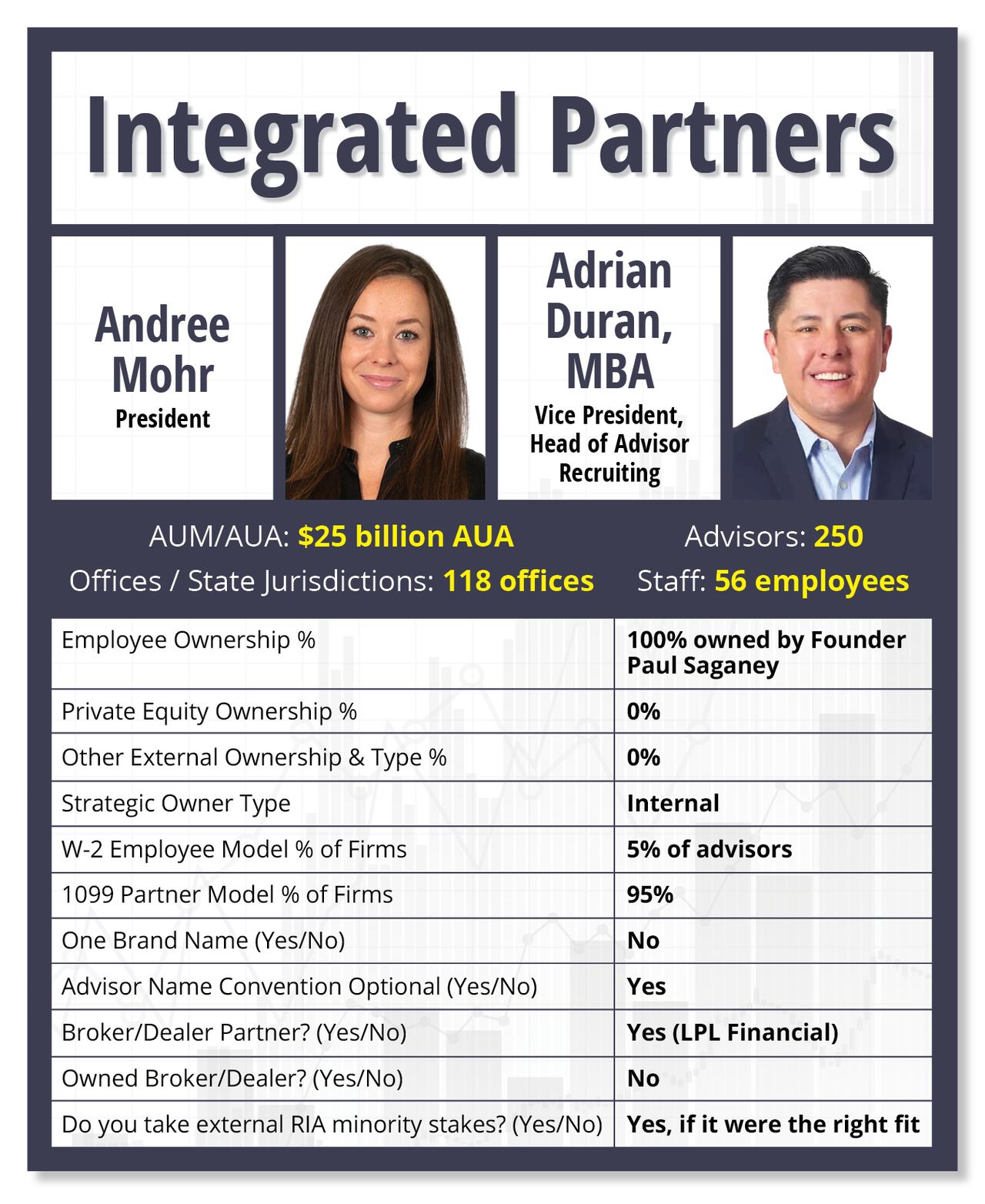
Integrated Partners is celebrating its 30th anniversary this year, reaching the milestone of $25 billion in assets under management and advisement. And the firm has done that without taking any outside capital or external investors. In fact, the company is still 100% owned by founder Paul Saganey.
Integrated President Andree Mohr says that’s by design; after 30 years in business, the core vision and culture of the firm haven’t changed. And that’s resonating with potential advisors, who don’t want to join a private equity-backed organization. Year-to-date, the firm has recruited advisors representing $4 billion in total assets.
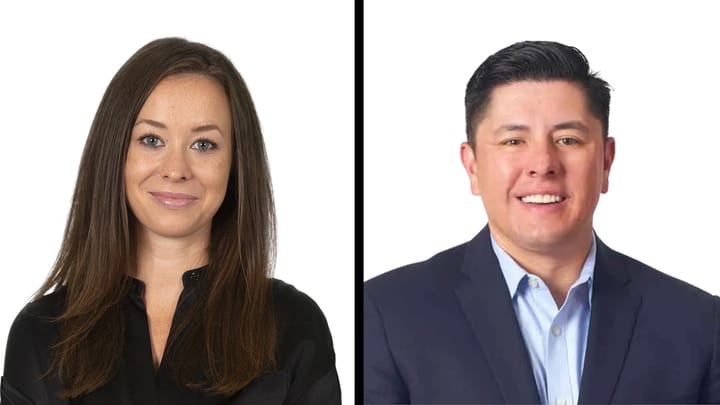
Wealth Management recently talked with Mohr and Adrian Duran, head of recruiting, about the firm’s evolution, succession plan and programs for developing younger advisors.
The following has been edited for length and clarity.
Wealth Management: Tell me about the firm’s history.
Andree Mohr: The history goes back to 1996 when Paul Sagney, our CEO and founder, started the firm. Paul was working with business owners and high-net-worth individuals, and he realized how uncoordinated their financial lives were because they had all of these different financial advisors, CPAs, insurance brokers. We always say our name is a description of what we do for our end clients. We wanted to bring financial coordination to their lives, and we knew that CPAs were a client’s most trusted advisor. We said if we can monetize their most trusted advisor status by partnering our advisors with CPAs, then we could grow a scalable and sustainable organization. So 30 years later, that core vision of our firm, the core culture of our organization hasn’t changed.
What has changed is how we execute on that vision, how we operate the organization and things like that. But we are still all in on business owner clients. We are still all in on the fact that most of the clients lack coordination in their financial lives and need somebody to bring that chaos into clarity, and that partnering with CPAs is a way that we can continue to grow the business sustainably and scalably.
WM: Integrated’s network of CPAs is called the CPA Alliance. What does that look like today?
The one thing that has evolved significantly in the last 30 years because of the changes in rules and regulations is that our CPAs, our solicitors, depending on each state, don’t need to be licensed, and we create wealth management entities for them. Andree Moore CPA firm becomes Andree Moore Wealth Management, and the Integrated Partners advisor becomes the wealth advisor for Andree Moore CPA. We’ve created these wealth management entities that we can co-brand under so that we can support the marketing and growth efforts of the CPA’s wealth management entity. It is still their entity that they own, but we are helping them to grow the business, and then we are obviously the financial advisor behind that wealth management entity.
When we started the program, we always said that we wanted to be a guest in their home. We wanted to build relationships with the CPAs so that we could solve the problems their clients are facing. And because we still have that mentality—we lead with planning, we lead with the fact that we are problem solvers, provide advice and solutions to support the CPA and their clients—the program works really well. We can build that trust and confidence so they refer those clients to us.
WM: What’s the history of the firm’s ownership structure?
AM: It’s been Paul always. He’s the sole owner.
WM: How has the core culture of the firm that Paul built in 1996 translated into the firm’s ownership decisions?
AM: I think that everybody understands that we have created a destination where entrepreneurial-minded advisors thrive, and in order to do that, we need to make decisions that are in the best interest of the advisor. And in order to make decisions that are best for the advisor and ultimately their end client, we have to be able to control those decisions. We don’t have to make decisions because we have to report up to a board, or we have specific revenue metrics we have to hit.
Now, of course, as a leadership team, we have goals and objectives for the organization that we have to make sure we’re hitting, and we are stewards of the organization. But we know we can play the long game. We can make decisions that are best for the long-term health of Integrated, our advisors and our clients without having to chase short-term return.
That core ethos has allowed us to create a culture of people who are really dedicated to advisors and the clients and the problems that we solve for people.
WM: Was there a point when the firm came to the decision to stay independently owned and not take outside capital?
AM: It’s always been what we’ve talked about; we never wanted to compromise the advisor and the advisor’s experience, but at the same time, we have to make sure that we are creating a platform that can evolve and be competitive. Nobody’s going to stay if we can’t keep up with technology and products and planning ideas and solutions just for that mindset. We’ve been lucky enough to be in the industry for many years, have a lot of close friends, see the headlines, see what’s going on and realize that for us it’s the right choice for now.
WM: Do you get approached by private equity firms or other capital providers?
AM: Every day.
WM: How do you respond?
AM: With that same mindset, “Thank you, we see what you’re doing. Everybody’s working hard. We believe in abundance. There’s plenty of business out there for everybody, but the right decision for us is to keep doing what we’re doing.”
There is obviously a balance when people want us to add new things or pay for things. Sometimes we have to balance between “Hey, we’re not private equity owned, and we’re going to try to figure everything out.” And that’s where I love our team; we do the best we can to support the business and be creative and evolve this platform.
WM: Will you reconsider taking outside capital at some point? You said this is the right decision “for now.”
AM: No, I don’t. I don’t think so.
WM: A lot of other firms, whether they’re private equity-owned or not, have paths to equity for either the leadership team or the advisors. Do you have any kind of program like that?
AM: We don’t have a program today for advisors to be equity owners. It is something that we will always pay attention to. We will always stay intellectually curious.
WM: What does your succession plan look like?
AM: We do have a succession plan in place. Yes, I am a part of it, as well as a few other members of our leadership team to ensure that the vision of Integrated can continue on. Paul has done a lot of planning, and the team has done a lot of planning from that perspective.
Under the plan, there would be no change to the operations of Integrated. It wouldn’t have a significant effect on the advisors or our team. We would be sad if Paul were gone, but the beauty of what we’ve created is that it will continue on, and that’s important. Especially for founder-led organizations, it is not solely dependent on the founder. We have a very good job ensuring that we have very good leadership in the core components of our organization, so it could continue on as it is.
WM: Is that what was behind the leadership change in 2024, with you coming on as president and Paul stepping back a little bit?
AM: Yes, because in founder-led businesses, the founder ends up being the de facto person who decides, and people come to. So we started to build up and empower leaders in their roles, but making that shift for me to become president shows that we have put a plan in place that will continue Integrated on and also allow other leaders to really step up in their roles.
WM: Are there specific leaders that you’re talking about that you see that kind of stepped up, moved up, besides yourself?
AM: I’d say everybody on our team. We have amazing leaders like Adrian Duran, head of advisor recruiting, our chief compliance officer, our head of financial planning has done a lot of really exciting work around integrating planning with insurance and bringing new technology into the space. Our chief investment officer has significantly grown the platform in the last couple of years integrating, again, new technologies, new products for advisors, but while at the same time making sure that we are still focused on planning and that the investments are supporting the plan.
We have some really exciting rising talents within the organization because our intention is to create a forever company. We’ve spent a lot of time growing and developing associate advisors, that next generation of advisors, but also the next generation of leadership at Integrated.
WM: Speaking of next gen, what programs do you have to develop younger advisors?
AM: So, at the end of last year, we gave Josh Benson the role of vice president of advisor development, and that’s been a really exciting transition for the organization. We’ve always been focused on training and development. That is core to what Paul has done, and we’ve always had the Integrated Academy with training classes and things like that.
But with Josh’s leadership, we have decided to create four different paths for our advisors. And so we have these mastery series for people to really move up-market and get better business owner planning or complex estate planning, things like that. We have focused on two tracks for the operational team members. We always talk about advisors, but they are powered by the teams behind them, and we wanted to make sure that we had channels to support them as well. And then we created an associate advisor track.
Josh runs a monthly training class. We have a study group on top of that. They do role-playing. They talk about cases together. They talk about the challenges they are facing and best practices. We wanted to create a group that could learn together and communicate with each other. There are about 20 to 30 associate advisors across all of Integrated, working underneath our advisors who have different specialties.
Josh has also launched a learning management system, so there’s more scalability to it.
WM: Earlier, you were talking about having the resources to invest in the technology and the services to stay competitive. Where does that capital come from to invest in the business?
AM: A lot of it comes from the business itself. We have to be very intentional about the decisions we make, what we invest in, how we grow the organization. We do that through working with our leadership team. We also have an ambassador council at Integrated Partners. So we look to that ambassador council to help us say, “Hey, is this truly what you as the advisor need in order to grow your business and compete and optimize your operations?” That allows us to continue to evolve the platform very thoughtfully, but also in a way that is right for us.
WM: Adrian, when you’re out there recruiting advisors, how are you talking to them about the ownership structure of the firm and the lack of outside capital?
Adrian Duran: It speaks for itself; year to date, we’re almost at $4 billion recruited.
Our story speaks for itself because a lot of advisors out there don’t want the PE firms. It’s very foreign for anybody to wrap their mind around what we do, but when people really understand autonomy and entrepreneurship, they 100% understand. And they say, “We don’t want a firm that’s PE-backed. We want to be able to make decisions on our own, and we want to build our own enterprise value and have someone to partner with us.” So I think it’s very much resonating out in the public.
WM: Does the firm feel any pressure to take outside capital at all?
AD: We’ve built a model that’s around advisor autonomy, ownership and long-term relationships, and those are the people that are seeking us out. The pitfalls of not having PE money from my seat, there is none, because the people that are seeking us out are the advisors that are looking for the opposite of a PE firm.
AM: I would say it’s intentional that we don’t feel that way. This has been a series of very deliberate decisions that have been extremely well executed that have gotten us to where we are today. And so we don’t feel the pressure, but we do have to be creative for sure and make sure that we’re doing things that will help to continue to evolve the platform. But we care so much about our culture. We care so much about our people that we have a team that focuses on ensuring that we meet the demands of what our advisors need, what our clients need, and we find solutions that work for Integrated and their clients and our advisors.