In addition to the inherent complexity of private markets as investments, gaps in the technology landscape have posed another challenge.
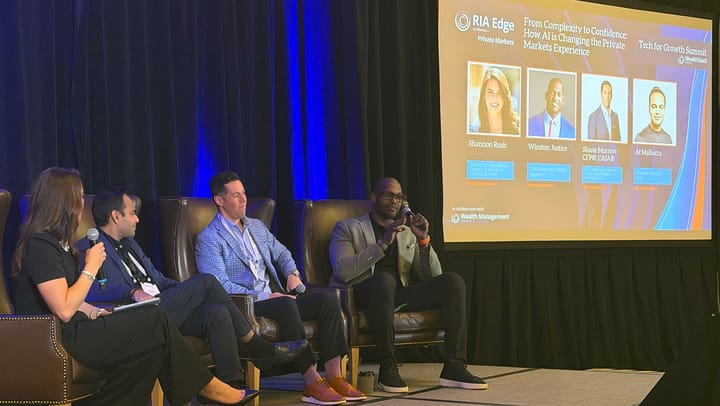
A series of panels at the RIA Edge Private Markets event held last week in conjunction with RIA Edge Austin grappled with some of the sticking points, including digitizing manual processes, integrating private markets data into CRMs, improving clunky reporting infrastructures and figuring out how to integrate artificial intelligence into the process.
The Back Office Reckoning
The biggest shared theme during the day’s discussions was that, despite the market being flooded with private-markets tech platforms, many pain points persist, and parts of the private-market investment process remain manual for many firms.
For example, Sam Miller, executive vice president of investment strategy with Signature Estate & Investment Advisors, which has about 10% to 15% of its managed assets in alternatives, said the firm’s private markets platform remains a “work-in-progress” that’s been “built of necessity.”
“One of the common gripes is having to enter the same information into multiple systems, which is a mind-numbing process,” Miller said.
Milissa Hutchinson, managing director and head of U.S. Wealth, Nomura Asset Management, said that general partners, fund administrators, custodians and front-end platforms are still too often operating in silos and manual processes continue to cause errors.
“It is nowhere near to a point of being scalable,” Hutchinson said. “There are a lot of really interesting things being done across the industry to try to automate and to make each of these parts of the chain talk to each other so that we can actually scale all of this. We’ve solved the access point and created ease there to some degree … but the rest of the business is still operating off of how public markets operate, but it doesn’t fit.”
Joe Raieta, head of investments at RIA Snowden Lane Partners, added that the differences in how small and large RIAs operate add another challenge. Larger firms can embed more competencies in-house, which changes their tech needs compared to smaller RIAs that rely more on third parties.
“You have some of the larger RIAs effectively running their own investment management businesses,” Raieta said. “So, you have a wealth management platform operating more like a home office structure where you have multiple analysts and CIOs and investment committees and the ability to do your own co-investments, and maybe you’re building your own funds. “There’s a lot of different flavors that go into how some of the larger firms operate versus if you’re a single producer or a smaller RIA, and you’re serving a part of your community. Doing all of those other things would make no sense.”
However, large RIAs can end up with a different problem. Inorganic growth means that firms could end up with a Frankenstein’s monster tech stack.
“They keep adding a new shiny toy without ever taking a step back,” said David Coyle, head of growth with wealthtech Aqua. “I’ll talk to firms, and they’ll say, ‘We use this for direct investments and this marketplace and this for our client portal,’ and all of a sudden, you’ve got five vendors on top of their traditional portfolio management. They’re also planning their CRM, their data aggregation, their marketing, and it just becomes the Dr. Seuss machine.”
Aprio Wealth Management CIO Simeon Wallis described how his firm has addressed that problem by building an AI agent using Claude to streamline post-merger integration processes. The agent ingests a new firm’s positions and cost basis from Orion and generates per-account transition plans based on each client’s tax status. Wallis estimated the agent has saved Aprio “hundreds of hours.”
The Role of Artificial Intelligence
Not surprisingly, panelists on several sessions discussed how AI is being embedded in private market processes.
Matt Saffi, vice president, business development—alternative solutions, with private markets platform iCapital, said the biggest near-term value for AI is distilling information for client conversations.
“One of the biggest complexities is assessing liquidity and risk exposure,” Saffi said. For example, “when you understand what the gating constraints are for every fund you are putting clients in a position so you can have a conversation and showcase the different risks, but also the benefits of the liquidity constraints.”
SagePoint Capital Partners CEO Winston Justice, meanwhile, described how the firm applies AI at the top of its deal funnel to screen deals against the firm’s investment policies, such as hurdles, liquidity bands and sectors. That screen then outputs a clear “no” for funds that don’t match and flags funds that pass those policies for human review.
“We get the opportunities that we need to focus and drill down on and the opportunities that really fit our families,” Justice said. “Getting to the ‘no’ faster is valuable, and I think anyone that tells me different is really trying to sell you something.”
Shane Morrow, CEO and managing partner at IronBridge Wealth Counsel, said his firm uses AI for education and to provide guardrails for analysts less experienced with private markets. IronBridge has also worked to develop prompts that can deliver consistent outputs for parsing prospectuses, operating agreements and other investment documents.
“There’s a wide berth of dispersion in the private space versus public space,” Morrow said. “And a lot of times, analysts, without a lot of experience … can make false assumptions. So we use it very centrally in providing guardrails and the box that alts fit in with for us. … There are a lot of shiny objects out there, but using AI from an educational standpoint, and from a research standpoint, can help translate, to first principles, why these things should be under consideration.”