
(Bloomberg) — Morgan Owens, a wellness, media and lifestyle entrepreneur, recently checked herself and her 7-year-old bichon frise, Ralph, in for a staycation to the Lytle Hotel in Cincinnati. There, they watched Netflix, and dined on room service. (Ralph enjoyed his own steak and rice.) Owens got a massage at Mitchell’s Salon & Day Spa across the street, and Ralph literally touched grass in all the green spaces.
“I’ve been so work-focused — our generation, we’ve been through Covid, DEI funds were recently pulled from my business, the list goes on — so the last thing on my mind has been having a child,” Owens says. The 40-year-old may be in a committed, cohabitating relationship, but when it comes down to choosing between solace and planning for kids, “I’m going to swing towards the luxury hotel.” Provided Ralph can come along.
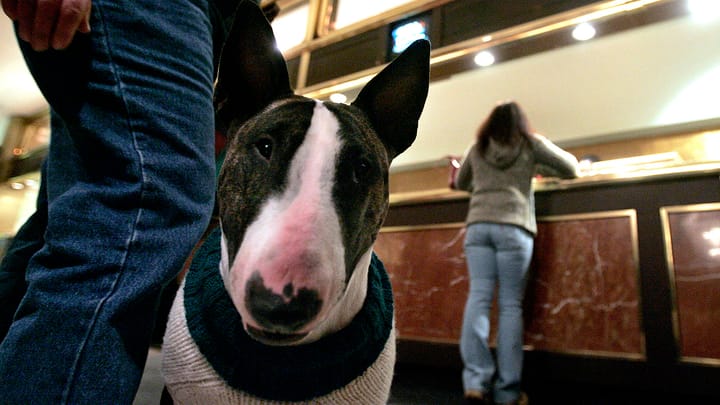
Couples known as Dinkwads — double income, no kids, with a dog — are becoming a potent force in travel. Forgoing kids because they don’t want them or they still can’t afford them despite the dual income, these couples are filling that emotional space with pets to the point of treating them like children. And hotels are stepping up to meet the modern family by providing more canine-inclusive luxury services, from gourmet dog menus to fur-baby-tailored spas.
“The US is a quite hostile place for raising children. There are so few supports for families, everything from high costs of daycare to limited protection for parental leave. … The cost of everything has gone up,” says Lindsay Bryan-Podvin, who’s in her late 30s and a financial therapist with a weekly newsletter. “I’m seeing more people choose to stay, or come to terms with staying, in a Dinkwad relationship.”
Some 53% of Americans owned pets in 2025, with millennials making up the largest percentage, according to an American Pet Products Association report. Pet industry expenditures are projected to reach $165 billion this year, up from $158 billion in 2025. Per a recent Morgan Stanley survey, 34% of respondents from age 18 to 34 intend to get a pet — and it’s this group shelling out even more cash on them.
“It’s less about spoiling your dog and more about this is what I have the ability to do,” says Bryan-Podvin. “People are saying, ‘Yeah, I can’t support a kid, but you know what I can afford? A dog and the 50 extra bucks a night to take it on vacation.’”
Shipyard Beach, a pristine stretch of South Carolina sand, was the last place I expected to spot a goldendoodle romping near the dunes, when I visited last year. Dudley Do-Right has been Sonesta Resort Hilton Head Island’s beloved mascot ever since his owner, recreation manager Kathie Sendra, brought him here as a puppy in 2025. When not keeping a close eye on the treats at check-in or greeting everyone from business executives to honeymooners, Dudley is supervising the beach toy rentals. The very good boy is a very visible (and very adorable) example how dogs are being welcomed at the upper end of luxury.
Through the Pets Are Welcome at Sonesta (PAWS) program, four-legged guests are greeted at check-in with a welcome letter and treats. Rooms feature thoughtful essentials like a cozy pet bed, and the grounds feature designated walking and potty areas, as well as pet-friendly dining.
Charlie Dice, a 38-year-old Dinkwad and author of Substack from Erie, Pennsylvania, thinks of her dogs as her kids to the point of applying some child-rearing logic to raising her pets: “My husband and I try to have two dogs at any given time, because like with kids, we think it’s good to have a sibling.”
She takes their two full-grown Bernese mountain dogs everywhere, from the Upper Peninsula of Michigan to the Netherlands and Norway, via commercial carriers. She has looked into semiprivate services such as Wheels Up and VistaJet, where pets don’t have to go into the hold, and dedicated companies like Bark Air, which launched with $6,000 one-way transcontinental US flights for dogs.
Bark just marked two years in business and has added Tokyo to international routes that include Stockholm, Athens and Berlin. It has also introduced an end-to-end pet concierge service.
For Dice, switching up her travel plans because a hotel can’t accommodate dogs is a given. “We look for facilities that cater to dogs,” she says. “If our dogs can’t go, we would never leave them behind in a kennel.”
“Getting to spend more time with them while they’re here,” she continues, “that’s the real luxury, because they’re not here as long as we are, unfortunately.”
Denver’s OG boutique hotel, Hotel Teatro, understands just how much dogs can shape where and how long guests stay. General manager Courtney Griffith says that’s a big part of why the hotel has waived fees: “Pet fees can feel a bit transactional when you’re placing this fee on someone’s fur-baby.”
“Ultimately, Dinkwads tend to travel more often, stay longer when they find a place they love and become highly loyal,” she adds. In a recent study, 26% of dog owners cited dog care while traveling as the second-biggest challenge associated with ownership. (No. 1? Cleaning up after them.)
“Some people will reach out before their stay, saying they have an allergy, and we are very upfront with them about our dog-friendliness,” Griffith says. “We are a dog destination. We understand if we are not the hotel for them.”
Sanctuary Beach Resort in Monterey, California, renovated in 2024 as a luxury experience for guests who want to embrace all that travel has to offer — especially with their dog in tow. “I’m a SINK [single income, no kids] from NYC, and after Covid, I think everyone engaging in hustle culture realized how important it is to take a break,” says Kelli Sturges, director of guest experiences and programming.
“We’re a place to unplug, which in DINK culture is a really big need,” she continues. “When you don’t have family obligations, you have extra hours to work, so DINKs get more tech burnout.”
The resort’s proximity to the Bay Area and an already dog-friendly private stretch of protected sand dunes made it easy to rebrand toward Dinkwads, especially with spacious, standalone cottages that allow lots of room to roam without your dog infringing on other guests’ privacy.
“None of this makes you feel beholden to someone else’s life choices,” Sturges says. “Sometimes guests will ask to be roomed farther away from dogs, but we see the same thing happen with guests that have kids.” (One of my favorite things in Hilton Head was seeing Dudley Do-Right scurry into the sea while knowing there was more beach to escape to if I wanted to avoid the barking.)
“The key to traveling with your dog is to look for a property that offers things you can do together,” says Sydney Durieux, a Dinkwad in her early 50s and owner of a 5-year-old West Highland white terrier, Sir William Wallace.
She regularly takes him from New York to Kilkea Castle in County Kildare, Ireland, where all-legged guests can meander through Mullaghreelan Woods (including with a pup picnic lunch basket), take in the Wolfhound Experience (where dog guests can meet and interact with the castle’s iconic enormous Irish hounds) or simply kick back at property’s traditional Irish pub.
They’re also a great icebreaker if meeting people is important in your travels. “People will come up to me and my dog all the time,” Durieux says. “I think people are willing to be more open and friendly with you when you have a little dog jumping up to say hi to everyone. It’s a great conversation starter.”
For Dice, it’s even more fundamental: “I like seeing the world through my dog’s eyes — it’s probably the same as with kids. With a new place, they get all excited.”